Symposia S5
29-30 Jun 2026
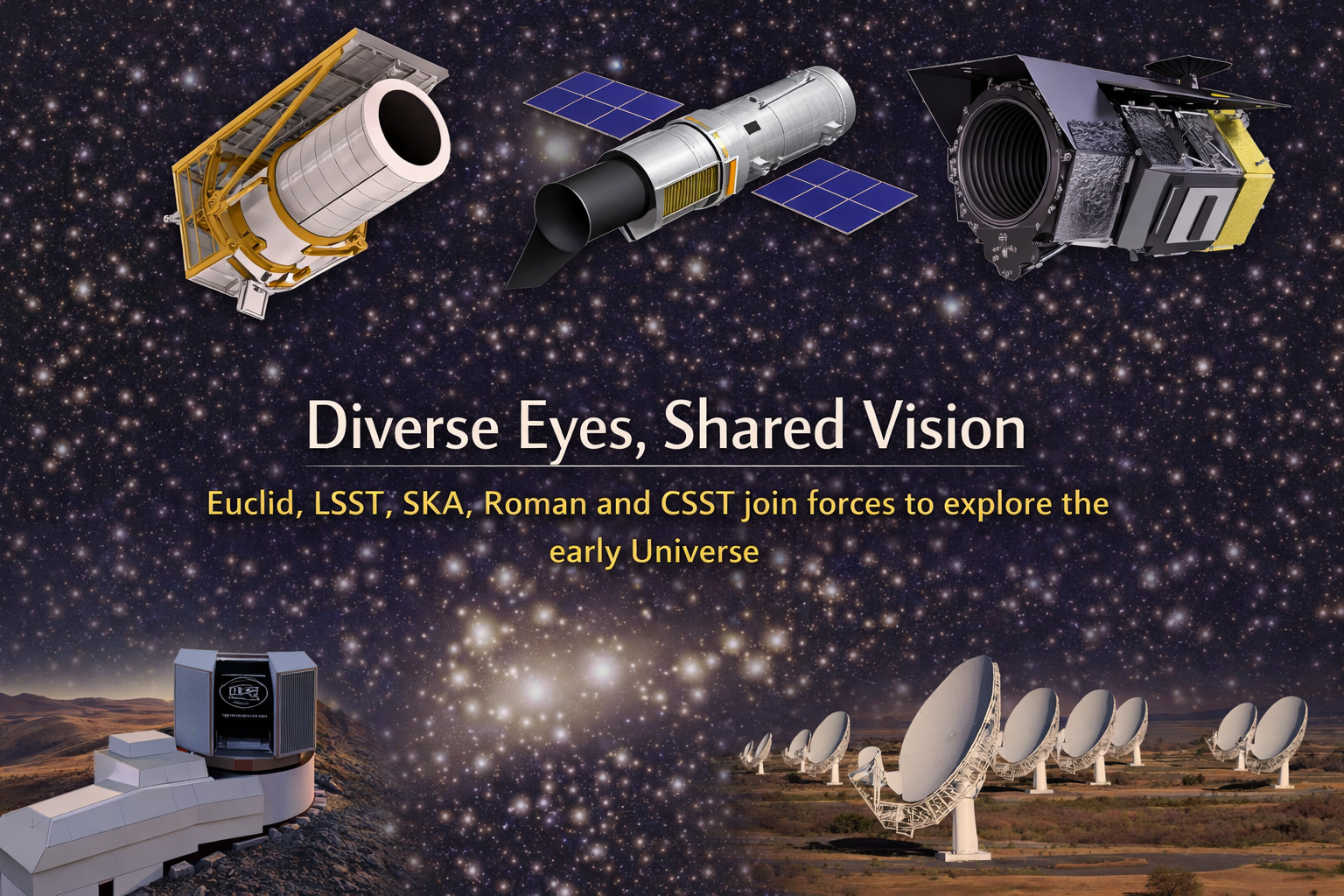
Diverse Eyes, shared vision: Euclid, LSST, SKA, Roman and CSST join forces to explore the early Universe
Aims and scope
The next decade will mark a transformative chapter in our exploration of the early Universe. A new generation of flagship observatories, Euclid, LSST, the Nancy Grace Roman Space Telescope (Roman), the Square Kilometre Array (SKA), and the Chinese Space Station Survey Telescope (CSST), is enabling a shift from standalone observations to a truly multiwavelength, multi-scale view of galaxy formation, evolution, and structure assembly in the first few billion years of cosmic history.
Together, these facilities will allow us to confront some of the most fundamental questions in astrophysics: How did galaxies grow and transform during cosmic dawn and cosmic noon? How did the first large-scale structures emerge from the primordial density field? And how did baryons and dark matter co-evolve to shape the cosmic web we observe today?
Answering these questions requires data that span wavelengths, tracers, scales, and physical regimes. This is where these observatories become truly transformative: mapping the cosmic web and its environments requires the wide-field depth of Euclid, LSST, and CSST, while uncovering the internal physics of galaxies at peak growth (2 < z < 3) demands the deep spectroscopic and multiband imaging capabilities of Roman and CSST. Tracing the gas that fuels star formation and black hole activity, and its exchange with the intergalactic medium, relies on the unique radio capabilities of the SKA. No single mission can address these challenges alone, but their synergy will offer an unprecedented, all-inclusive view of the early Universe.
Image Credits
Composition created using ChatGPT 5.2 over the following images:
@CAS: https://english.cas.cn/newsroom/cas_media/202205/W020220507506118887542.jpg
@ESA: https://www.esa.int/ESA_Multimedia/Images/2023/11/Euclid_s_view_of_the_Perseus_cluster_ of_galaxies
@Euclid Consortium: https://www.euclid-ec.org/wp-content/themes/astra-child/EuclidAnniversary /images/satellite.png
@NASA: https://roman.gsfc.nasa.gov/gallery-spacecraftillustrations.html
@SARAO: https://www.sarao.ac.za/wp-content/uploads/2020/08/2018-MeerKAT-1_small.jpg
@Vera C. Rubin Observatory/NSF/DOE: https://rubinobservatory.org/gallery/collections/main-gallery/q911l572sd08t8mdgjv0lf097k
Programme
The symposium is structured around six thematic blocks. Five focus on major facilities—Euclid, LSST, SKA, Roman, and CSST—highlighting their latest results and their potential to address fundamental questions in galaxy evolution and large-scale structure in the early Universe. The final block showcases the power of cross-facility synergies. Together, these themes define the key scientific topics of the meeting:
- The Emergence of Large-Scale Structure: How multiwavelength surveys are mapping the cosmic web and identifying forming clusters, and how cross-survey approaches can connect galaxies to their evolving environments.
- Galaxy Populations at Cosmic Noon: Strategies for combining deep spectroscopy, imaging, and radio data to build a comprehensive picture of star formation, baryon content, and feedback during the peak of galaxy growth.
- The Reionization Era and the First Massive Systems: Current and planned efforts to link early galaxy populations, quasars, and the intergalactic medium, and to explore their role in shaping the ionization and chemical state of the young Universe.
- Cosmology and Fundamental Physics from Joint Surveys: New approaches to combining probes of galaxies, gas, and large-scale structure to refine cosmological models and test fundamental physics beyond the reach of individual observatories.
Invited speakers
- Olga Cucciati (INAF-OAS, Italy)
- Jacqueline Hodge (Leiden University, Netherlands)
- Mireia Montes (Institut de Ciències de l'Espai, Spain)
- Jinyi Shangguan (KIAA-Peking, China)
Scientific organisers
- Helmut Dannerbauer (IAC, Spain) — co-Chair
- Mark Dickinson (NOIRLab, USA)
- Zuhui Fan (SWIFAR-Yunnan University, China)
- Katarzyna Małek (Narodowe Centrum Badań Jądrowych, Poland)
- Sophie Maurogordato (Observatoire de la Côte d'Azur, France)
- Simona Mei (Université Paris Cité, France)
- Jose Pérez-Martínez (IAC, Spain) — Chair
- Mark Sargent (École Polytechnique Fédérale de Lausanne, Switzerland)
- Nick Seymour (Curtin University, Australia)
- Lingyu Wang (SRON, Netherlands)
- Toru Yamada (JAXA, Japan)
- Xianzhong Zheng (Tsung-Dao Lee Institute, China)
Contact
jm.perez @ iac.es / helmut @ iac.es
Updated on Wed Feb 25 23:58:51 CET 2026
|
 A power cut will shut down all EAS services on Tuesday, 10 January 2017 starting at 7:30 CET.