Symposia S7
29-30 Jun 2026
Gaia, at the dawn of Gaia DR4, preparing for DR5 and beyond
News:
- 20260102 Session Information updated.
Aims and scope
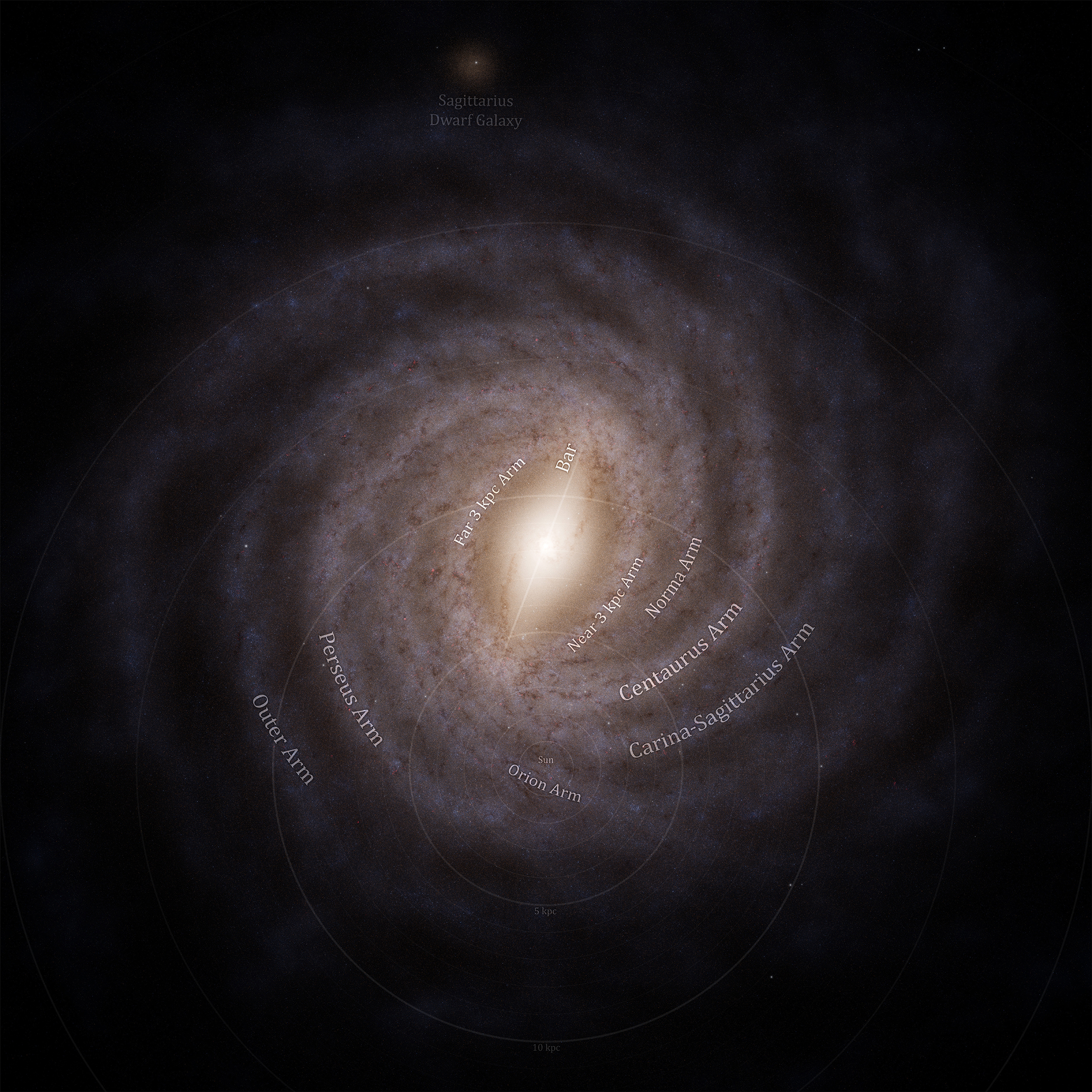 The ESA Gaia mission continues to revolutionise our understanding of the formation history of the Milky Way, and is having a significant impact on many other areas of astronomy ranging from solar system science to quasars.
The intermediate Gaia Billion Star Census of the Milky Way, was released in June 2022 as Gaia Data Release 3 (Gaia DR3: based on the first 34 months of mission data). This release contains the full five parameter astrometry for ~1.5 billion sources, along with low and medium resolution spectra and a wealth of associated data (such as mean radial velocities for brighter objects, see https://www.cosmos.esa.int/web/gaia/data-release-3 for details)). Subsequently, the Gaia Focused Product Release (Gaia FPR: October 2023) provided a set of five high value data products, spanning solar system objects to gravitational lenses.
The key goals of this symposium will be for the Gaia/GREAT(*) and related communities (and especially early stage researchers) to present and discuss their science highlights resulting from Gaia DR3 and Gaia FPR. It will allow the Gaia project to update the science community with the latest scientific and technical performance of Gaia, review the most recent Gaia enabled science, and provide a look ahead to the December 2026 seminal release of Gaia DR4, the full release of the 5 year Gaia nominal mission. In particular presentations will cover the new Gaia DR4 data products (e.g. extended time series data, including full epoch astrometry, photometry, spectroscopy, and astrophysical parameters for well over 2 billion sources, see https://www.cosmos.esa.int/web/gaia/data-release-4) and updates from the performance verification activities, and planning for the range of training and outreach activities to take place around the December data release day.
GREAT plenary meetings have run since 2009, allowing members of the GREAT and wider community to participate in a dynamic fashion. They are structured around
Gaia updates, presentations from related organisations (e.g. ESO), reports from
new initiatives, and new science results from the network activities.
This will be the 19th GREAT plenary (which since 2012 have been organised within
the high impact EAS EWASS - see the links to online materials at
http://great.ast.cam.ac.uk/Greatwiki/GreatHome for the Gaia/ GREAT symposia held
at the EWASS's in Rome (S5), Turku (S11, SM5), Geneva (S3), La Laguna (S9),
Athens (S1), Prague (S2), Liverpool (S2), Lyon (SS28), Leiden-virtual (S10), Leiden-virtual (S15), Valencia (S12), Krakow (S3), Padova (S10) and Cork (S1) ? most talks available online at https://great.ast.cam.ac.uk/Greatwiki/GreatMeet-PM18). Programmes for all earlier GREAT plenaries can be found at https://great.ast.cam.ac.uk/Greatwiki/GreatHome, where the breadth of topics covered and quality of presentations is apparent.
The symposium will include space for updates on initiatives aimed at optimising or leveraging the data from Gaia, together with presentations on the science topics where Gaia will have the highest impact. One focus of the main symposium will be to update on the GaiaNIR mission (a concept proposed for the ESA Voyage 2050 Large mission 5 launch slot, see https://www.cosmos.esa.int/web/voyage-2050). This is timely in that the science case and baseline mission parameters for GaiaNIR will need to be updated in advance of mission selection in the coming few years.
In addition we will organise a lunchtime session, providing an update of the Gaia Data Archive, and plans for its future enhancements. The lunch session will also include a set of poster lightening talks (PSPs) for the highest evaluated poster contributions.
(1) GREAT (an initiative of the ESA Gaia Project, Gaia Science Team and Data
Processing and Analysis Consortium (DPAC) Executive) is a pan-European research
network involving over 1000 researchers in 20+ countries with a common interest
in maximising the science potential of Gaia ( http://www.great-esf.eu). GREAT, recently in
the form of the MW-Gaia COST Action ( https://www.cost.eu/actions/CA18104) (2019-2023) and the MWGaia Doctoral Network ( https://www.mwgaiadn.eu/) (2023-2027) was/is financially supporting networking activities across Europe.
Programme
- Gaia DR3: Highlight Science including a review of recent major science highlights from Gaia DR3, Gaia FPR and science discovery enabled by Gaia, with attention to the potential of Gaia DR4 and look ahead to Gaia DR5.
- Gaia / GREAT/MW-Gaia / Gaia Unlimited Status plus update on GaiaNIR status towards Voyage 2050/ L5
- Gaia EDR3/DR3/FPR: Highlight Science (The Milky Way as a Galaxy)
- Gaia EDR3/DR3/FPR: Highlight Science (The Birth, Life and Death of Stars)
- Gaia EDR3/DR3/FPR: Highlight Science (from Solar system to reference frames)
- Gaia networking and ground based synergies with Gaia
- Lunch session with an update on the Gaia Archive and Data Access, activities within the MW-Gaia Doctoral Network and also an opportunity for
poster presenters to deliver a 'lightening' talk of their (e-)poster.
Invited speakers
The speakers and programme will be available on this EAS 2026 website and also on the GREAT website - see http://great.ast.cam.ac.uk/Greatwiki/GreatMeet-PM19
- Session 2 will include Gaia status update talks from Johannes Sahlmann (Gaia), Anthony Brown and Antonella Vallenari (DPAC), Nic Walton (MW-Gaia/GREAT)
- All other session talks will be contributed presentations.
Scientific organisers
The co-Chairs are Nicholas Walton (Institute of Astronomy, University of Cambridge, UK), Anthony Brown (Leiden Observatory, Leiden University, NL), Johannes Sahlmann (ESAC, ESA) and Antonella Vallenari INAF-Padua, IT).
Contact
Nicholas Walton (naw at ast.cam.ac.uk)
Updated on Mon Jan 12 14:45:10 CET 2026

 A power cut will shut down all EAS services on Tuesday, 10 January 2017 starting at 7:30 CET.