Symposia S8
29-30 Jun 2026
A multi-faceted view of accretion at super-Eddington rates
Aims and scope
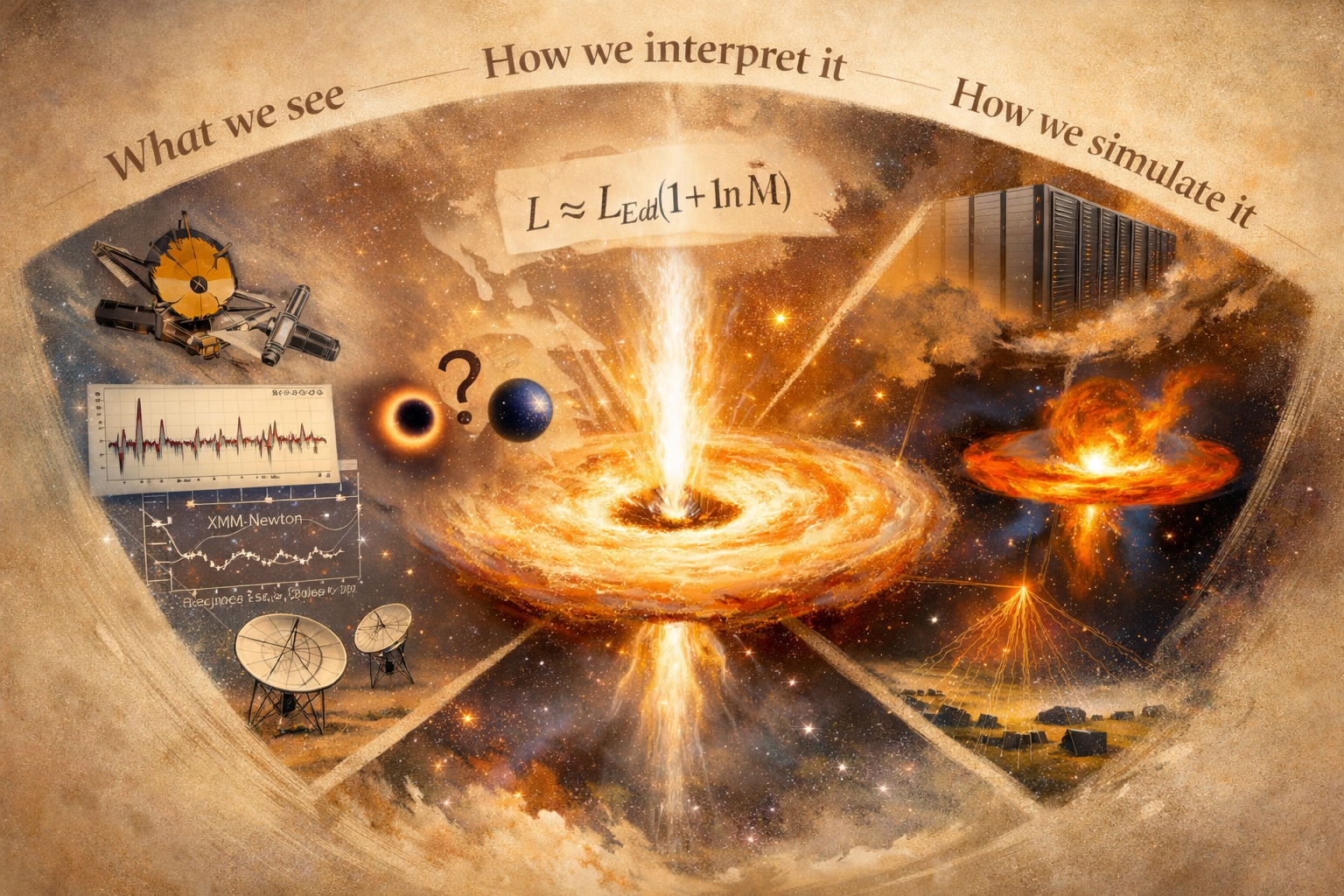
Super-Eddington accretion represents one of the most challenging frontiers in high-energy astrophysics, with implications ranging from the rapid growth of the first supermassive black holes to the rich phenomenology of nearby compact accretors. Deep surveys with facilities such as HST, JWST, XMM-Newton and Chandra have revealed quasars hosting billion-solar-mass black holes at z > 6, when the Universe was less than a billion years old. Explaining their existence requires sustained accretion episodes that likely exceeded the canonical Eddington limit, yet the physical mechanisms enabling such growth remain highly debated. Theoretical models predict that radiation-pressure-driven winds and outflows can significantly regulate both accretion and feedback; however, observational constraints remain scarce at high redshift.
Fortunately, the nearby Universe provides accessible laboratories where super-Eddington accretion can be studied in detail. These include ultraluminous X-ray sources (ULXs) powered by stellar-mass compact objects, microquasars, and tidal disruption events (TDEs), the latter perhaps connected to the "little red dots" discovered by JWST. Recent discoveries, such as pulsating ULXs, relativistic outflows, and multimessenger connections, underscore the diversity and complexity of these systems. Importantly, there is growing evidence that the environment surrounding ULXs and microquasars can be promising sites for very-high-energy particle acceleration, supported by recent detections from HAWC and LHAASO, while observational and theoretical evidence suggest that both TDEs and ULXs could contribute to the production of astrophysical neutrinos. Furthermore, ULXs might represent a key phase of high-mass X-ray binary evolution and their study can provide useful constraints for population synthesis models and binary evolution channels that lead to gravitational waves progenitors. Taken together, these results underscore the importance of comprehensive studies of nearby super-Eddington accretors, not only for advancing black hole cosmology but also for understanding feedback processes across a wide range of astrophysical environments.
With the advent of current and upcoming facilities (XRISM, Athena, Rubin Observatory, JWST, ELTs, etc.), the field is entering a transformative phase. This symposium aims to bring together experts across different communities (X-ray, gamma-ray, optical/IR, radio, theoretical and numerical modeling, multimessenger astrophysics, cosmology) to provide a comprehensive picture of accretion at super-Eddington rates. By linking local laboratories with the high-redshift Universe, we will address the following questions:
- What have we learned so far from observations and theoretical modelling of accretion and outflows? What is the role of magnetic fields in pulsating ULXs?
- Does super-Eddington accretion build the first super-massive black holes?
- Can we draw meaningful parallels between super-Eddington sources at high redshift and nearby systems (e.g. ULXs and TDEs)?
- What can be inferred from multiwavelength studies on the environment of ULXs and from recent LHAASO discoveries?
- What is the contribution to astrophysical neutrinos from super-Eddington accretors?
- What insights do population synthesis studies provide?
- What key observational and theoretical challenges must be tackled in the coming decade of multiwavelength and multimessenger astronomy?
Programme
- Theory of super-Eddington accretion and role of the magnetic field
- Observational properties of ULXs
- Population studies
- Feedback to environment (e.g. bubbles), PeV accelerators and neutrinos
- JWST latest results: Little red dots and early black hole growth
- Super-Eddington accretion in TDEs
Invited speakers
- Jane Lixin Dai (The University of Hong Kong)
- Anastasios Fragkos (University of Geneva)
- Alexander Mushtukov (University of Oxford)
- Samar Safi-Harb (University of Manitoba)
More to be confirmed.
Scientific organisers
Roberta Amato (co-chair), Georgios Vasilopoulos (co-chair), Matteo Bachetti, Johannes Buchner, Felix Fuerst, Gianluca Israel, Konstantinos Kovlakas, Chandreyee Maitra, Christian Malacaria, Enrico Peretti, Ciro Pinto, Dominic Walton, Natalie Webb
Contact
For any further information you can contact us at:
roberta.amato @ inaf.it or gevas @ phys.uoa.gr.
Updated on Mon Jan 19 14:53:50 CET 2026


 A power cut will shut down all EAS services on Tuesday, 10 January 2017 starting at 7:30 CET.