Special Session SS13
1 Jul 2026
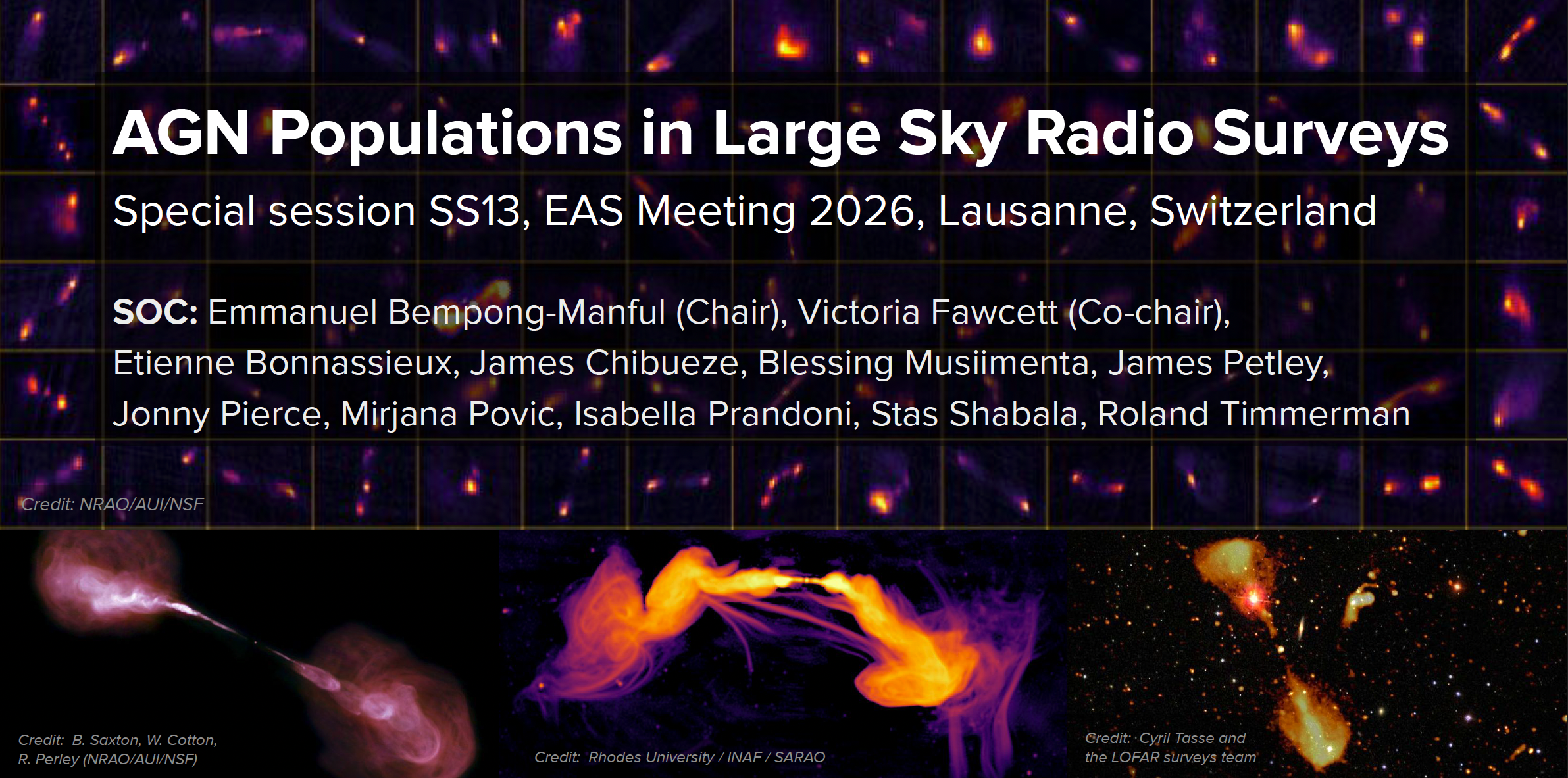
AGN populations in large sky radio surveys
Aims and scope
Over the last few decades, large sky radio surveys have been at the forefront of astronomy, including surveys such as FIRST, VLASS, and LoTSS. These surveys have become increasingly sensitive, with a wide frequency range and impressive spatial resolutions, opening up an exciting new era in radio astronomy. Additionally, with the development of the SKA and precursor facilities such as MeerKAT and ASKAP, sensitive surveys of the radio sky in the southern hemisphere are now increasingly receiving more coverage (e.g., EMU, MIGHTEE, MGCLS, etc.). Of particular interest in all of these surveys are the fascinating cosmic objects active galactic nuclei (AGNs). Although AGNs make up a relatively small minority of the entire galaxy population in the Universe, activities of the radio AGN sub-class are implicated in feedback, structure formation, and supermassive black hole (SMBH) growth, and therefore understanding their co-evolution is essential to our understanding of how galaxies and large-scale structures form and evolve over cosmic time.
With these new radio surveys probing, for the first time, the "radio-quiet" population of AGNs, this has also opened up many questions. For example: what is the nature of radio-compact/unresolved sources? How important are low-powered radio jets, shocks, and jet-driven outflows in AGN feedback? Why do certain AGN populations display different radio properties? Is there a real dichotomy between radio-loud and radio-quiet AGN? What is the impact of radio jets on the properties of AGN host galaxies, including star formation? With the combination of these sensitive radio surveys with multi-wavelength data and predictions from simulations/theory, we are at a pivotal time in our understanding of the radio production and impact within AGN, especially at the radio-quiet end.
This special session will examine the wealth of scientific results in AGN population studies produced in recent years from large sky radio surveys including: jet-ISM interaction, feedback from radio jets and shocks, multi-scale physics with VLBI, predictions from radio jet/wind simulations, and the connection with host-galaxy properties and environment as revealed from multi-wavelength data.
The primary objective of this EAS special session is to bring together communities of observers working on AGNs in large area radio surveys, with insights from across the EM spectrum and predictions from simulations/theory. This session will explore the wealth of discoveries enabled by large area surveys in recent years, as well as facilitating new collaborations in the field and paving the way towards early science with the SKA.
Programme
Our special session will cover observational and theoretical works aimed at understanding AGN populations in large sky radio surveys. The session will consist of three blocks covering different themes relating to:
- Block 1: Theme: Radio AGN-host galaxy properties and environment: a multi-wavelength perspective
- Block 2: Theme: Radio-mode AGN feedback, structure formation and SMBH growth
- Block 3: Theme: Results from SKA precursor surveys: paving the way for early SKA science
Invited speakers
- Martin Hardcastle (University of Hertfordshire, UK)
- Francesca Panessa (INAF, Istituto di Astrofisica, Italy)
- Imogen Whittam (University of Oxford, UK)
Scientific organisers
- Emmanuel Bempong-Manful (Chair; University of Manchester, UK)
- Victoria Fawcett (Co-chair; ESO, Germany)
- Etienne Bonnassieux (CNRS/LAB Bordeaux, France)
- James Chibueze (University of South Africa, South Africa)
- Blessing Musiimenta (INAF-OAR, Italy)
- James Petley (Leiden University, The Netherlands)
- Jonny Pierce (University of Hertfordshire, UK)
- Mirjana Povic (IAA-Spain/SSGI-Ethiopia/MUST-Uganda)
- Isabella Prandoni (INAF, Istituto di Radioastronomia, Italy)
- Stas Shabala (University of Tasmania, Australia)
- Roland Timmerman (Durham University, UK)
Contact
Updated on Thu Feb 19 09:57:08 CET 2026


 A power cut will shut down all EAS services on Tuesday, 10 January 2017 starting at 7:30 CET.