Special Session SS2
29 Jun 2026
Ultra-faint dwarf galaxies: the final frontier?
Aims and scope
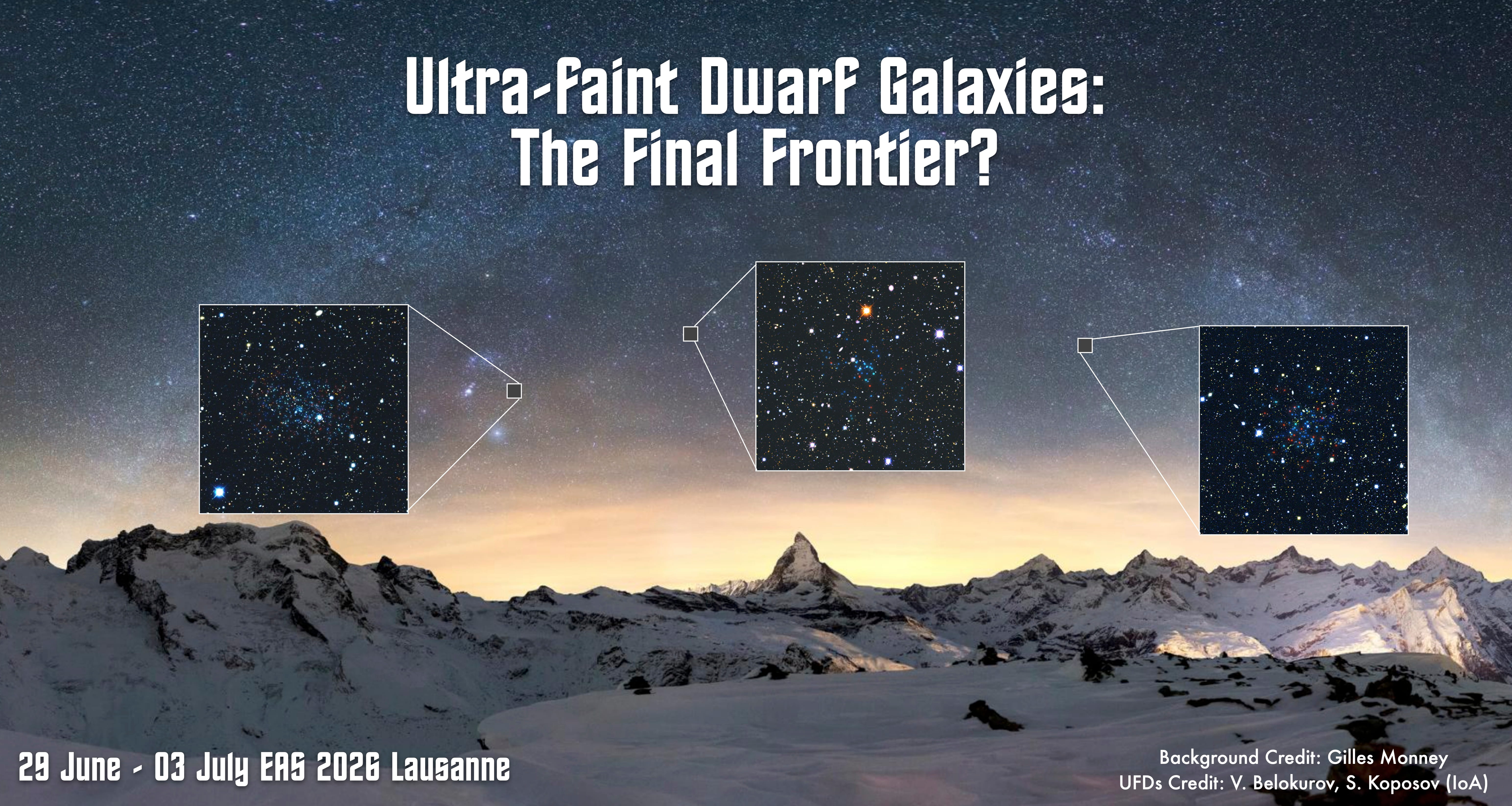
Ultra-faint dwarfs (UFDs) populate the low-mass end of the galaxy luminosity function. These systems are characterised by extremes: they are the oldest, most metal-poor and most dark matter-dominated galaxies known. However, they are also the most elusive, challenging our current understanding of galaxy formation.
Most UFDs have been discovered only in recent years thanks to the advent of wide-field surveys (SDSS, PS1, DES, HSC-SSP, UNIONS) and the Gaia mission. These surveys have revealed more than 50 systems around the Milky Way (MW), with stellar masses that can be as low as a few tens of solar masses. Current facilities, such as the Vera Rubin Observatory and the Euclid mission, are expected to uncover hundreds of additional systems, as well as remnants of disrupted satellites embedded in the MW halo.
Yet, confirming the galactic nature of candidate UFDs is far from trivial. Their sizes and luminosities overlap with those of the faintest globular clusters, making classification ambiguous. Robust confirmation requires spectroscopic follow-up to probe their internal velocity dispersion and metallicity spread.
A complete census of satellite UFDs is one of the most discriminating tools for inferring the nature of dark matter. Current cold dark matter models predict the largest number of satellites around MW-like galaxies, thus rendering the precise determination of the MW satellite luminosity function crucial.
Furthermore, thanks to their shallow potential wells, UFDs provide a rigorous test-bed for baryonic physics in cosmological simulations, including feedback processes, reionisation, and chemical enrichment in the early Universe.
Finally, UFDs are fossil records of the high-redshift universe. Their old stellar populations offer rare access to the chemical traces of the first generations of stars, for which direct observational evidence remains scarce.
The field is entering an exciting period with the arrival of the first results from 4MOST, LSST, Euclid, JWST, along with new high-resolution simulations. Together, these will allow us to study the UFD regime in unprecedented detail.
The aim of this Special Session is to bring together observers and theorists in order to explore key open questions in the ultra-faint dwarf galaxy regime.
Programme
- Detection and classification: how can UFDs be efficiently detected in current and upcoming surveys, and how securely can they be distinguished from globular clusters?
- Star formation histories: how does star formation proceed in UFDs, and how does it depend on stellar mass and environment?
- Dynamical masses and dark matter properties: how can we robustly assess the total masses of UFDs, and what do they reveal about the nature of dark matter?
- The impact of spectroscopic surveys: how will current and upcoming spectroscopic facilities and surveys reshape our understanding of UFD kinematics, chemistry, and demographics?
- Computational frontiers: what technical and numerical challenges do simulations face in modelling UFDs, and how can they be overcome?
- Connection to the high-redshift Universe: what can stellar chemical abundances in UFDs teach us about Population III stars, and can we link local UFDs to galaxies observed by JWST at high redshift?
Invited speakers
- Massimiliano Gatto (INAF Osservatorio Astronomico di Capodimonte)
- Terese Hansen (Stockholm University)
- Isabel Santos-Santos (Durham University)
Scientific organisers
- Pascale Jablonka (co-Chair, EPFL, CH)
- Salvatore Taibi (co-Chair, EPFL, CH)
- Giuseppina Battaglia (Instituto de Astrofísica de Canarias, ES)
- Anirudh Chiti (Stanford University, USA)
- Justin Read (University of Surrey, UK)
- Camilla Hansen (Frankfurt University, DE)
Contact
salvatore.taibi @ epfl.ch
pascale.jablonka @ epfl.ch
Updated on Fri Feb 27 16:57:53 CET 2026


 A power cut will shut down all EAS services on Tuesday, 10 January 2017 starting at 7:30 CET.