Special Session SS21
29-30 Jun 2026
Preparing for PLATO's science data: mission insights and community engagement
News:
Submit your abstract - Deadline 3 March 2026
Aims and scope
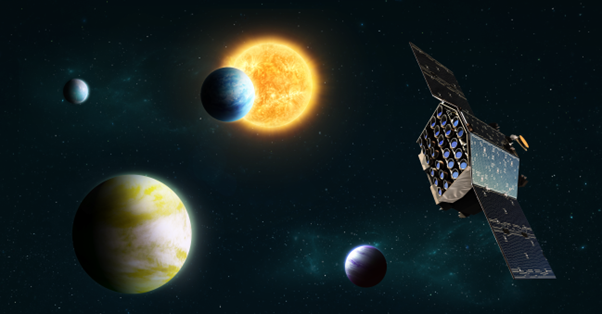
ESA's PLATO mission, scheduled for launch in early 2027, is primarily designed to detect and characterise exoplanets in orbits up to the habitable zone of Sun-like stars. By performing high-precision photometric measurements of more than 150,000 bright stars per field, PLATO will be able to detect transits of terrestrial planets with orbital periods of up to 1-year. With the complement of asteroseismology analysis and radial velocity observations from ground, the mission will substantially expand the catalogue of characterised exoplanets with precisely known radius, mass, and age. Asteroseismology of thousands of targets will enable the determination of stellar properties with unprecedented accuracy, significantly advancing our understanding of stellar structure and evolution. Additionally, PLATO's Guest Observer program will support a variety of supplementary scientific investigations based on community-submitted proposals.
By the time of the EAS 2026 annual meeting, the tests of the spacecraft and the ground segment will have nearly completed, and the PLATO teams will be working towards the launch and operational readiness of the mission. The evaluation of proposals for the Guest Observer Programme will be in progress.
The overall aim of this Special Session is to showcase the forthcoming PLATO capabilities and data and provide the latest information for their scientific exploitation.
In this context, the first part of the session will consist of invited talks that will provide updates to the community regarding the mission's expected performance, the PLATO Input Catalogue, and the science operations preparation. The latter will include information on the facilities for community support and data access, and the public data releases. A second series of invited talks will describe the pipelines that generate the light curves and process the exoplanet and stellar science products. The status of the Ground-Based Observation programme for the follow-up of the planetary candidates will also be explained.
In the second part of the session, the community is invited to present developments on data analysis techniques and models relevant for the interpretation of the PLATO data. In addition, we welcome contributions associated with exoplanet, stellar and complementary science topics that will benefit from PLATO's capabilities.
Programme
Invited speakers
Scientific organisers
- Ana M. Heras (ESA/ESTEC, The Netherlands) - Chair
- Heike Rauer (DLR, Germany) - Co-Chair
- Kévin Belkacem (Observatoire de Paris, France)
- François Bouchy (University of Geneva, Switzerland)
- Juan Cabrera (DLR, Germany)
- J. Miguel Mas-Hesse (CSIC/INTA, Spain) - Co-Chair
- Giampaolo Piotto (University of Padova, Italy)
- Don Pollacco (University of Warwick, UK)
- Gavin Ramsay (Armagh Observatory and Planetarium, UK)
Contact
Ana Heras (ana.heras @ esa.int)
Updated on Fri Mar 27 17:46:03 CET 2026


 A power cut will shut down all EAS services on Tuesday, 10 January 2017 starting at 7:30 CET.