Special Session SS24
2 Jul 2026
WST in the 2040s landscape: the power of synergies.
Aims and scope
The main goal of this special session is to highlight and discuss with the astronomical
community the strong synergies that the Wide-field Spectroscopic Telescope (WST) will
have with other major observatories in the 2040s.
WST is designed as a 12m aperture telescope with simultaneous operation of a large field-of-view (3 sq. degree), high-multiplex (30,000) multi-object spectrograph (MOS) with two spectral resolutions (R~40,000 and 4,000) and a giant 3x3 arcmin integral field spectrograph (IFS).
Given the current investment in deep imaging surveys and noting the diagnostic
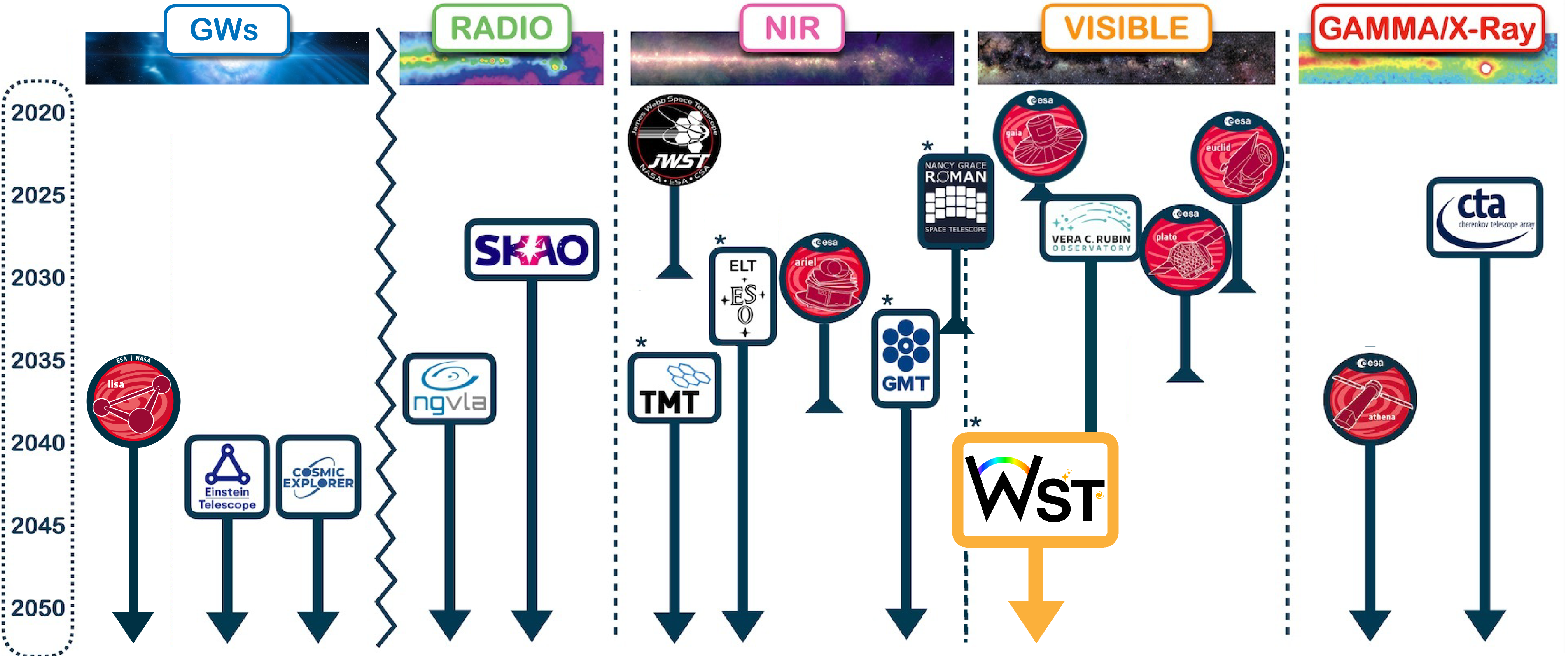
power of spectroscopy, the WST will fill a crucial gap in astronomical capability; it will work in synergy with future ground and space-based facilities and will allow these to realise their exploiting the full scientific potential. For instance, the WST's spectroscopic capabilities would ideally
complement the photometric and time-domain deep surveys carried out by
Rubin/LSST. Space missions like Euclid and Nancy Roman will provide detailed
photometry and morphological information for very large samples of galaxies, which will
be key for complementing the spectral properties derived with WST. Even in the 2040s a major fraction of the
stars with exquisite astrometry from Gaia will still lack fundamental spectroscopic
information. Strong synergies will be present between WST and the SKAO; for example,
WST has the potential to provide identification and redshifts for the large populations
of radio continuum sources that SKAO will be sampling on large areas of the sky, while
its IFS will provide a complementary view of HI-detected galaxies from the SKAO by mapping their ionised gas. The third generation of gravitational wave
detectors (Einstein Telescope and Cosmic Explorer) will provide unprecedented
sensitivity for detection of the final state of mergers in binary systems of neutron stars or
black holes.
The unique combination of field of view, sensitivity and multiplexing of WST will be
crucial to detect and characterise the electromagnetic counterparts of such events (e.g.
kilonovae). In addition, WST spectroscopic surveys will push significantly deeper
in redshift and completeness than is currently possible, and this will be a key
resource for exploiting the GW events as dark sirens and placing independent constraints on H0. Finally, the extensive spectroscopic
database
generated by WST will serve as an ideal pool for the selection of targets for detailed follow-up
at high spectral or spatial resolution with new 30-40m class telescopes like the ELT.
This special session aims to bring together scientists from all these different communities, to discuss their needs, and strategies for enhancing the scientific output from the joint, synergistic exploitation of these facilities.
Programme
- WST concept and science
- Multi-messenger synergies
- Synergies in the time domain
- Synergies with space based observatories
- Synergies in the radio domain
Invited speakers
- Sara Bonito (INAF)
- Marica Branchesi (Gran Sasso Science Institute)
- Antony Brown(Leiden University)
- Naomi McClure-Griffiths(ANU and SKAO)
Scientific organisers
- Vincenzo Mainieri (Chair, ESO, DE)
- Roland Bacon (CRAL, FR)
- Cristina Chiappini (AIP, DE)
- Michele Moresco (UniBo, IT)
- Sofia Randich (INAF, IT)
- Paula Sanchez Saez (ESO, DE)
- Mark Sargent (EPFL, CH)
- Rodolfo Smiljanic (NCAC, PL)
- Susanna Vergani (Observatoire de Paris, FR)
Contact
Please contact Vincenzo Mainieri (vmainier @ eso.org).
Updated on Thu Feb 26 09:49:24 CET 2026

 A power cut will shut down all EAS services on Tuesday, 10 January 2017 starting at 7:30 CET.