Special Session SS26
02-03 Jul 2026
Planning the future of large-scale (sub-)mm astrophysics
Aims and scope
Observations at (sub-)mm wavelengths offer a uniquely powerful window into the cosmos, as they reveal regions and astrophysical states of matter that are generally inaccessible to any other wavelengths. From tracing the earliest stages of star and planet formation to mapping the evolution of galaxies across cosmic time, (sub-)mm astronomy has already transformed our understanding of the Universe. Nevertheless, as we look toward the 2030s, the limits of current (sub-)mm facilities are becoming increasingly clear. A new generation of instruments, combining high sensitivity, high spatial resolution, and fast mapping speed, is needed to tackle some of the most fundamental, yet still unanswered, questions in astrophysics and cosmology.
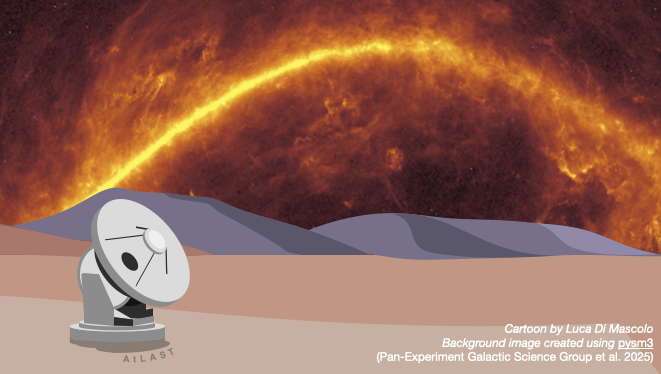
The Atacama Large Aperture Submillimeter Telescope (AtLAST) is a bold and visionary response to this challenge. Envisioned as a 50m single-dish telescope operating across 350 microns to 10 mm (30 - 950 GHz) with a field of view of 2 degrees, AtLAST will host up to six instruments simultaneously. AtLAST will be instrumental for the advancement of several frontier areas of astrophysics, including: 1. Revealing the hidden Universe: Identifying positions and redshifts of the currently elusive, "typical" (sub-)mm galaxy populations, providing, on the occasion, new targets for detailed ALMA and ELT follow-up; 2. Tracing the baryon cycle: Mapping the large-scale flow of baryonic matter in and around galaxies; 3. Measuring mass at all scales: Estimating the total mass of extended sources inaccessible to interferometers alone; 4. Exploring the dynamic sky: Opening the (sub-)mm window to time-domain and transient phenomena.
We are at a pivotal moment when strategic coordination and community-driven planning are crucial to ensure that future facilities align with evolving scientific priorities, while also addressing broader societal responsibilities, including environmental considerations and sustainable design. And as we shape the future of (sub-)mm astronomy, AtLAST offers an opportunity not just to build a new facility but to reimagine the future of astrophysical research.
Programme
Key questions to be explored during this Special Session include:
- Scientific frontiers: What groundbreaking astrophysical questions will demand AtLAST's capabilities in the 2030s?
- Synergies with other European research infrastructures: How can AtLAST complement current and future facilities and what strategies can be employed to maximise its scientific return?
- Data and accessibility: What computing infrastructure, archiving strategies, and AI-driven tools will be necessary to manage and ensure access to the vast data volumes from future (sub-)mm surveys?
- Sustainability: How can AtLAST be developed and operated in an environmentally, socially, and financially responsible way?
- Alignment with European strategic vision: This Special Session also serves as a forum to discuss the project in the framework of Europe's strategic vision in astronomy.
Invited speakers
- Akira Endo Delft University of Technology
- Alvaro Hacar University of Vienna
- Amélie Saintonge MPIfR, Bonn
- Katharina Immer ESO-Garching
- Sven Wedemeyer University of Oslo
Scientific organisers
- Hector Socas-Navarro (EST foundation) - Co-Chair
- Evanthia Hatziminaoglou (ESO, IAC) - Co-Chair
- Tony Mroczkowski (CSIC-ICE)
- Claudia Cicone (University of Oslo)
- Gina Panopoulou (Chalmers)
Contact
Héctor Socas (hector.socas @ est-project.eu), Evanthia Hatziminaoglou (ehatzimi @ eso.org)
Updated on Mon Feb 16 18:43:53 CET 2026

 A power cut will shut down all EAS services on Tuesday, 10 January 2017 starting at 7:30 CET.