Special Session SS27
02-03 Jul 2026
The Vera Rubin Observatory Legacy Survey of Space and Time: from data previews to full survey operation
Aims and scope
The
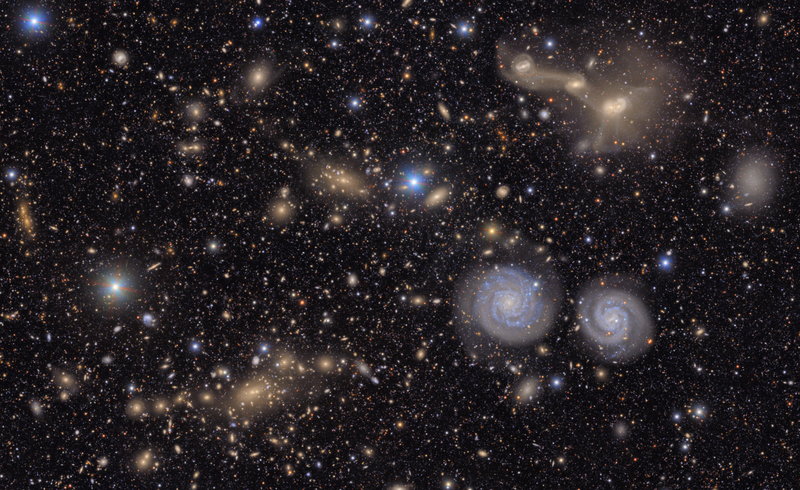
NSF/DOE Vera C. Rubin Observatory's Legacy Survey of Space and Time (LSST) will produce an astronomical dataset of unprecedented scale during its 10-year survey of the visible sky from Cerro Pachón in Chile. With the 3.2-gigapixel LSST Camera, the survey will characterize an estimated 20 billion galaxies, 17 billion resolved stars, and millions of Solar System bodies and Active Galactic Nuclei, all while generating a real-time public stream of 10 million alerts per night to enable rapid follow up of variable objects and transient phenomena.
Following the 2025 release of "First Look" images and Data Preview 1, the community has already transitioned from preparation to active discovery, with early science results and peer-reviewed papers now emerging. By the time of the 2026 EAS Annual Meeting, the observatory will have started the 10-year LSST survey, with nightly alerts from single-epoch images flowing to seven community brokers, and the first science-grade commissioning observations taken with the LSST Camera about to be released in Data Preview 2.
The European community stands as a critical partner in the scientific exploitation of this data. Over one thousand European scientists are currently engaged through the Rubin in-kind contribution program, providing vital infrastructure ranging from software development and computing resources to telescope time. In addition, the science exploitation of released Rubin-LSST data is coordinated via the eight LSST Science Collaborations and supported by numerous programs from the LSST Discovery Alliance.
Building on the success of the first edition, this Special Session is organized for the second consecutive year with the goal of unifying and strengthening the European Rubin-LSST community. As LSST transitions into full operations, sustained coordination, knowledge sharing, and inclusivity become essential to maximize scientific return. This session is designed not only as a forum to present early results, but also as a meeting point where experienced Rubin contributors and new users can connect, exchange expertise, and collectively shape the European role in the LSST era.
The final programme will be shaped by contributions from the community. Abstract submissions are welcome from researchers at all career stages and from all backgrounds, including both long-standing members of the Rubin community and those engaging with the LSST ecosystem for the first time.
Programme
- Provide an overview of the Rubin Observatory ecosystem and the current status of the LSST survey, covering observatory organization and operations, Rubin science collaborations, accessibility, education, and public engagement.
- Showcase the first science results from Data Preview 1 and the real-time alert stream, spanning the full scientific breadth of the survey: from Solar System science and the Milky Way structure to transients, variable stars, and the physics of the extragalactic universe.
- Highlight European contributions to infrastructure and data tools, explore cross-survey synergies, prepare for Data Preview 2, and identify opportunities for new involvement to ensure inclusive and equitable participation in both science-driven initiatives and broader activities such as education and public outreach, with dedicated time for discussion.
Invited speakers
- Zeljko Ivezic, Head of LSST, University of Washington (USA)
- Tesla Jeltema, Rubin LSST Science Collaborations Coordinator, University of California, Santa Cruz (USA)
- Emille E. O. Ishida, Fink Broker PI, CNRS/LPC Clermont (FR)
- Jakob Nordin, AMPEL Broker PI, Institut für Physik, Humboldt-Universität zu Berlin (DE)
- Heloise Stevance, Lasair Broker, Schmidt AI in Science Fellow, Oxford University (UK)
Scientific organisers
Angela Bongiorno (she/her, co-Chair), INAF - Roma, Italy
Sean MacBride (he/him, co-Chair), University of Zurich, CH
Giada Pastorelli (she/her, co-Chair), INAF - Padova, Italy
Eric Aubourg (he/him), CNRS-APC, France
Sara (Rosaria) Bonito (she/her), INAF - Palermo, Italy
Massimo Brescia, University Federico II and INAF - Capodimonte, Italy
Johann Cohen-Tanugi (he/him), CNRS - LPCA, France
Giulia De Somma (she/her), INAF - Capodimonte, Italy
Christos Georgiou (he/him), IFAE, Spain
Tobias Géron (he/him), University of Toronto, Canada
Leanne Guy, Rubin Observatory, Chile
Johan Knapen (he/him), IAC Tenerife, Spain
Katarzyna Malek (she/her), NCBJ, Poland
Ayan Mitra, NCSA, University of Illinois, USA
Karlo Mrakovcic (he/him), University of Rijeka, Croatia
Ilaria Musella (she/her), INAF - Capodimonte, Italy
Gautham Narayan (he/him), University of Illinois, Urbana-Champaign / NSF-Simons SkAI Institute, USA
Tanja Petrushevska (she/her), University of Nova Gorica, Slovenia
Silvia Piranomonte (she/her), INAF - Roma, Italy
Claudia M. Raiteri (she/her), INAF - Torino, Italy
Oleksandra Razim (she/her), University of Nova Gorica, Slovenia
Marina Ricci (she/her), CNRS-APC, France
Elham Saremi (she/her), University of Southampton, UK
Gyula M. Szabó (he/him), ELTE Gothard Obs., Szombathely, Hungary
Róbert Szabó (he/him) Konkoly Obs. CSFK HUN-REN Hungary
Matthew Temple (he/him), Centre for Extragalactic Astronomy, Durham University, UK
Akke Viitanen (he/him), University of Geneva, Switzerland
Contact
giada.pastorelli @ inaf.it
Updated on Mon May 18 13:42:47 CEST 2026
|

 A power cut will shut down all EAS services on Tuesday, 10 January 2017 starting at 7:30 CET.