Special Session SS3
3 Jul 2026
Out of the box, moving from morpho-kinematic classes to detailed analysis of galaxies in the early Universe
Aims and scope
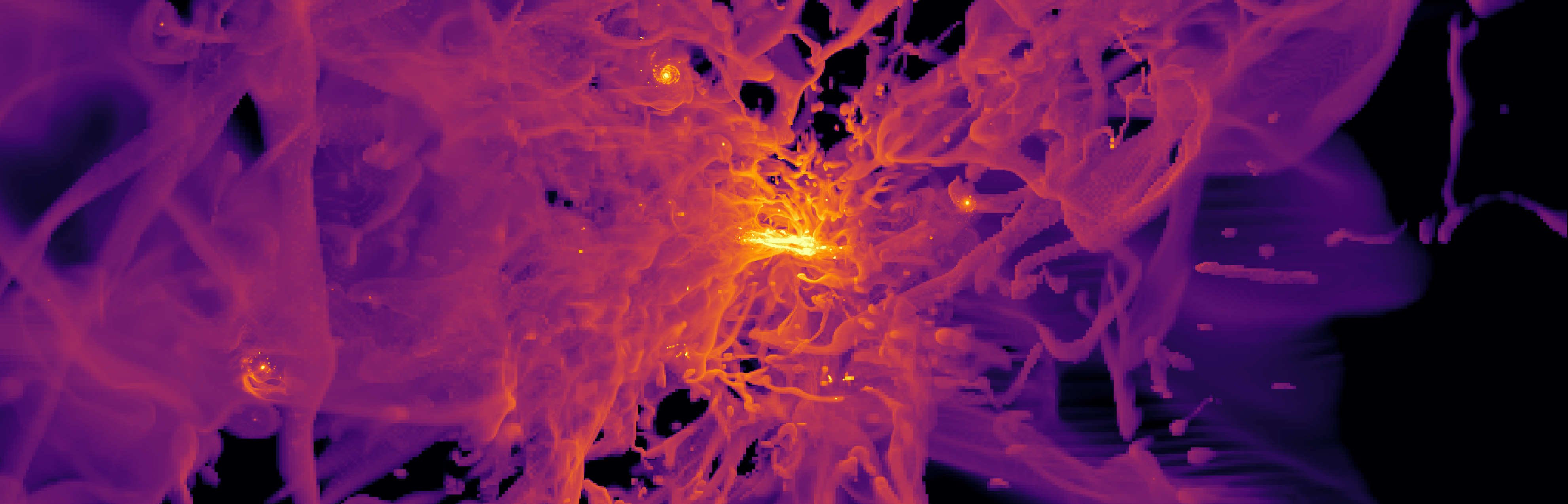
The kinematics of galaxies in the early Universe entail a number of phenomena (i.e., rotation, merging activity, in- and outflows), and are key observables for models of galaxy evolution. Current observations allow us to simultaneously determine the morphology, which informs us of the nature of galaxies (e.g., radial symmetry suggesting a relaxed nature, central bars that channel gas into the nucleus, disturbed distributions from mergers). ALMA opened a window into the gas morphology and kinematics of galaxies in the first 1.5Gyr after the Big Bang (z>4) through the strong FIR cooling line [CII]158um, revealing a diverse population of primarily mergers, and some rotating galaxies.
However, recent JWST/NIRSpec IFU observations have found that many galaxies classified as 'rotators' actually were small-separation mergers or had outflows from active galactic nuclei (AGN). Indeed, zoom-in cosmological simulations suggest that the kinematic state of galaxies evolves on short timescales and often include a combination of phenomena (e.g., rotation, merging, and outflows in the same galaxy).
We have reached a crucial inflection point where we no longer need to rely on simple classes (e.g., rotators, mergers) and modelling tools, but can now investigate the detailed kinematics of galaxies on sub-kpc scales.
Programme
This session will:
- Summarise the state of high-redshift kinematic studies: Morpho-kinematics results from low-resolution ALMA observations of high-z galaxies (e.g., ALPINE, REBELS), new findings from high-resolution ALMA (e.g., CRISTAL, TRICEPS, CONDOR) and JWST/NIRSpec IFU observations (e.g., GA-NIFS, REBELS-IFU), as well as current results from cosmological simulations.
- Examine the applicability of existing diagnostics (e.g., v/sigma, tilted ring models) to these complex systems in the early Universe.
- Discuss how to best characterise the complex kinematics of these sources, including the use of existing codes (e.g., GalPak3D, 3DBarolo, KinMS, MoKA3D), the combination of gravitational lens modelling and kinematic modelling, and the need for new modelling techniques.
Invited speakers
- Filippo Fratenali (Kapteyn Astronomical Institute)
- Mahsa Kohandel (Scuola Normale Superiore)
- Francesca Rizzo (University of Groningen)
Scientific organisers
- Gareth Jones (Kavli Institute for Cosmology, University of Cambridge)
- Nicholas Choustikov (University of Oxford)
- Enrico Di Teodoro (University of Florence)
- Lucy Ivey (Kavli Institute for Cosmology, University of Cambridge)
- Kiana Kade (Chalmers University of Technology, Sweden)
- Jan Scholtz (Kavli Institute for Cosmology, University of Cambridge)
Contact
gj283 @ cam.ac.uk
Updated on Tue Mar 03 15:43:42 CET 2026
|

 A power cut will shut down all EAS services on Tuesday, 10 January 2017 starting at 7:30 CET.