Special Session SS42
02-03 Jul 2026
Challenges ahead: How to deal with interference from satellite constellations
Aims and scope
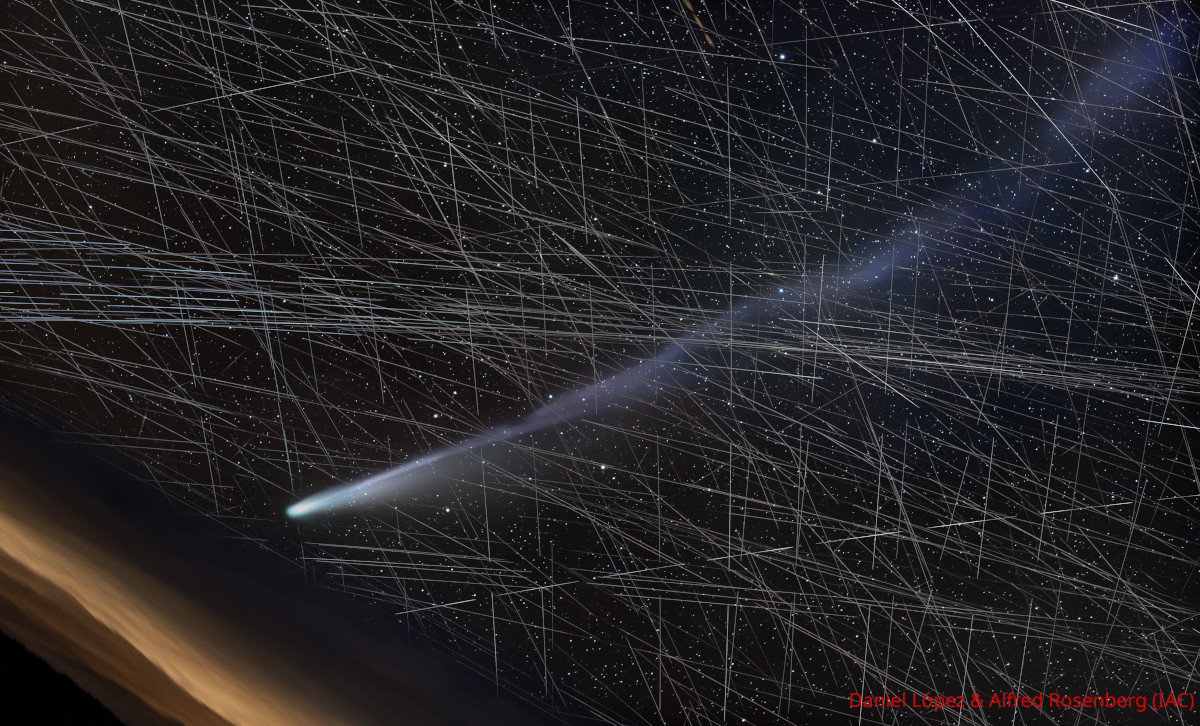 In 2019 SpaceX launched the first batch of 60 satellites for the Starlink constellation of Low Earth Orbit (LEO) satellites, with the aim of bringing high speed, low latency internet to remote regions. Only six years later, the number of Starlink satellites is about to reach 10,000, making up the majority of satellites in orbit. Several other private companies, national entities and militaries have published plans for their own telecommunication satellite constellations, resulting in a total of over a million individual satellites that are currently filed with the ITU.
Satellites from the existing constellations have had an unexpected negative impact on both optical and radio astronomy and have spurred the development of various mitigation strategies. Satellite engineers are trying to reduce the reflective brightness of the satellites, operators control the attitude of the satellites such that less light is reflected towards Earth and pause radio transmissions while satellites are above radio telescopes and astronomers developed strategies to avoid satellites and to remove interference from their data.
The IAU Centre for the Protection of the Dark and Quiet Sky (CPS: https://cps.iau.org/), funded by, NSF's NOIRLab and SKAO, supported by the EAS as a contributing member. brings together astronomers, policy makers and satellite operators, to work on reducing the impact on astronomical activities and the dark and quiet sky by large satellite constellations. While at present, national regulations and international treaties are insufficient to regulate this new frontier in satellite telecommunications, some operators are listening to the concerns of astronomers and are actively working to reduce their satellite constellation interference.
This session aims to update the astronomical community on strategies to mitigate the impact of satellite constellations and to set out opportunities for engagement and influence, through the CPS, the EAS, and via the national governments of conference delegates.
Programme
- The four strategic areas (SatHub, Industry and Technology Hub, Community engagement Hub, and Policy Hub) that the IAU CPS is involved in, and the work that is being carried out
- The types of mitigations currently available and under development by both operators and astronomers
- Measurements of radio astronomy impacts and SKAO mitigation strategies
- Development of regulatory frameworks and best practices for European states
Scientific organisers
Christopher Finlay (EPFL),
Stephan Hellmich (EPFL),
Noelia E. D. Noël (University of Surrey),
Kevin K. Gifford (CU Boulder),
Olga Zamora (IAC),
Robert Massey (EAS),
Connie Walker (NOIRLab, IAU CPS),
Mike Peel (Imperial College London, IAU CPS),
Olivier Hainaut (ESO)
Contact
stephan.hellmich @ epfl.ch
Updated on Fri Jan 30 10:05:24 CET 2026

 A power cut will shut down all EAS services on Tuesday, 10 January 2017 starting at 7:30 CET.