 A power cut will shut down all EAS services on Tuesday, 10 January 2017 starting at 7:30 CET.
|
|
|
Programme Overview
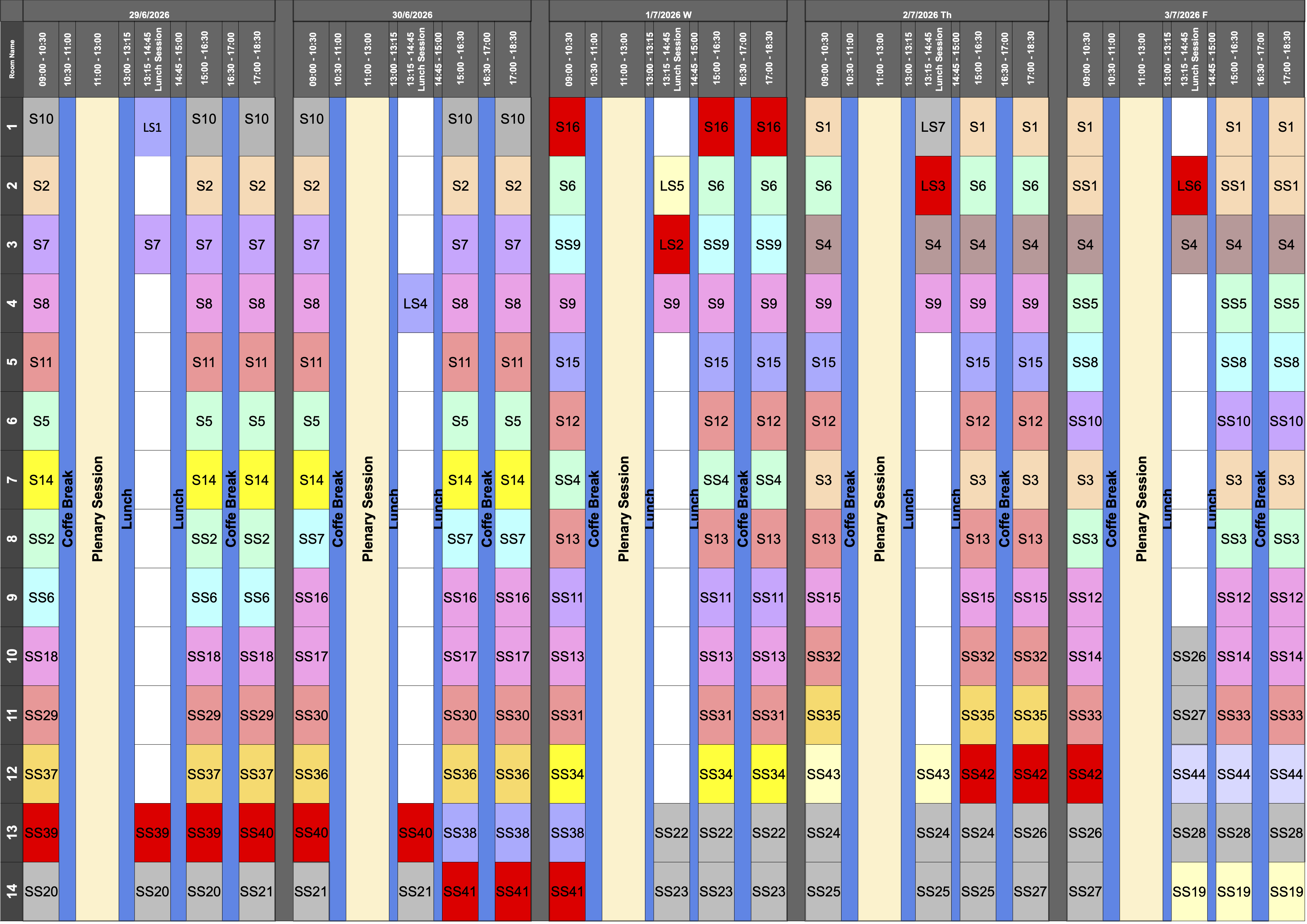
Parallel sessions
Sessions are colour-coded, indicating the broad scientific area, to facilitate
the day-to-day planning of your week.
| Cosmology |
Galaxy evolution |
Gravitational waves |
High energy/Black holes |
| Milky Way |
Interstellar medium |
Stellar astrophysics |
Astrochemistry/Atomic physics |
| Exoplanets & Planet formation |
Archives, Data Science & AI |
General |
Solar system |
| Surveys & Instruments |
Diversity & Welfare |
Development & Outreach |
|
Note that the indiviual session web pages are not available. Please look into the Interactive Programme for details of the session.
Symposia (may include blocks during lunch)
- S1 : Cosmology with wide spectroscopy surveys
- S2 : Science with gravitational lensing in the multi-space telescope era II: new prospects and opportunities
- S3 : The stellar route to H0: not only Classical Cepheids
- S4 : Preparing for multi-messenger observations with LISA and PTAs
- S5 : Diverse Eyes, shared vision: Euclid, LSST, SKA, Roman and CSST join forces to explore the early Universe
- S6 : Shaping galaxies and their gaseous environment in the early Universe
- S7 : Gaia, at the dawn of Gaia DR4, preparing for DR5 and beyond
- S8 : A multi-faceted view of accretion at super-Eddington rates
- S9 : The Rise and Shine of Rapidly Assembling Galaxies and Black Holes Since Cosmic Dawn
- S10 : Euclid: the first 2000 square degrees of the cosmos
- S11 : Globular clusters as tracers of galaxy formation and evolution: from dynamics to cosmology
- S12 : Supernovae and their remnants: from stellar death to galactic evolution
- S13 : Massive supergiants in focus: single, binary and stellar merger pathways across the Hertzsprung Russell Diagram
- S14 : From small-scale solar phenomena to stellar contexts: observational breakthroughs, theoretical advances, and space weather implications
- S15 : AI for astronomical discovery: Foundation Models, Machine Learning, Reliability, Sustainability, and the Effective Use of AI
- S16 : Future of European Astronomy
Special Sessions (may include blocks during lunch)
- SS1 : Unlocking the secrets of DM with low surface brightness observations
- SS2 : Ultra-faint dwarf galaxies: the final frontier?
- SS3 : Out of the box, moving from morpho-kinematic classes to detailed analysis of galaxies in the early Universe
- SS4 : The interplay between gravity and baryons: insights from low surface brightness galaxies
- SS5 : Stellar clumps and star clusters as building-blocks of galaxy assembly and evolution
- SS6 : From molecular clouds to galaxy clusters: towards a unified understanding of stochastic star formation in the early Universe
- SS7 : Mind the Gap â Bridging resolved and unresolved HII regions in star-forming galaxies
- SS8 : Local group star formation in the conditions of cosmic noon: seeing the impact of JWST
- SS9 : Multi-phase molecular gas in nearby and distant galaxies insights from ALMA and JWST
- SS10 : Resolving the missing details for the Milky Wayâs accretion history
- SS11 : Young stellar structures in the Milky Way
- SS12 : Accretion disc winds across mass scale
- SS13 : AGN populations in large sky radio surveys
- SS14 : From shadows to Jets: BH science with the EHT
- SS15 : Neutrinos from the Dark: unveiling hadronic processes in radio-quiet AGN coronae
- SS16 : Precision measurements of astrophysical jets across scales and sources
- SS17 : Timing of the accretion flow in compact objects: X-ray insights and multi-wavelength surveys
- SS18 : TeV astronomy: setting up the new generation of Cherenkov telescopes
- SS19 : Fostering Inclusion, Mental Well-being, and Leadership Equity in Astronomy
- SS20 : SKAO science verification and beyond: preparing users for the SKA era
- SS21 : Preparing for PLATOâs science data: mission insights and community engagement
- SS22 : Getting ready for Science with the Nancy Grace Roman Space Telescope
- SS23 : Transformative science from 30-Meter Class telescopes in the Northern hemisphere
- SS24 : WST in the 2040s landscape: the power of synergies
- SS25 : Optical Interferometry in the next decade: Science, Technology, and Collaboration at the VLTI and beyond
- SS26 : Planning the future of large-scale (sub-)mm astrophysics
- SS27 : The Vera Rubin Observatory Legacy Survey of Space and Time: from data previews to full survey operation
- SS28 : WEAVE and 4MOST â whole-sky spectroscopic coverage through next-generation facilities
- SS29 : The dance of stars within galaxies: transients, their progenitors and their host galaxies
- SS30 : A synoptic view of star formation with the VLTI and JWST
- SS31 : Exotic populations in star clusters seen through the lens of binary interactions
- SS32 : Kilonovae: further insights from theory and observations
- SS33 : Pushing the frontiers: precision spectroscopy of FGK stars
- SS34 : EST, the next-generation solar telescope
- SS35 : Exoplanets and the Galactic environment
- SS36 : Synergies between JWST and the ELT for the study of star and planet formation
- SS37 : Planet formation in sub-structured disks: from dust traps to giant planets
- SS38 : Machine Learning for Spectroscopy: unlocking galaxy and AGN physics with large surveys
- SS39 : Early Career astronomers and their supporters
- SS40 : Next steps towards greener astronomy
- SS41 : European forum of astronomical communities
- SS42 : Challenges ahead: how to deal with interference from satellite constellations
- SS43 : Saving astronomy in Ukraine: what can we do as a community?
- SS44 : AI and Open Access in Modern Astronomy Publishing
Lunch Sessions (single-block session during lunch)
- LS1 : Getting the most out of ESO data: a hands-on session on the ESO Science Archive and data processing tools
- LS2 : The ESA science program
- LS3 : Astronomy on Tap Europe Networking Lunch
- LS4 : The ESA Space Science Archives
- LS5 : Evaluating IDEAs (Inclusion, Diversity, Equity and Accessibility) in Astronomy Outreach and Education
- LS6 : EPFL Space Associations
- LS7 : VLTI 2026: entering the new sensitivity era
Plenary events
Please refer to the dedicated pages on Plenary Lectures
Restricted meetings
- EAS Council meeting 1 (Mon 13:15–14:45)
- EAS Affiliated Societies: business lunch (Tue 13:15–14:45)
- EAS Council meeting 2 (Thu 13:15–14:45)
|